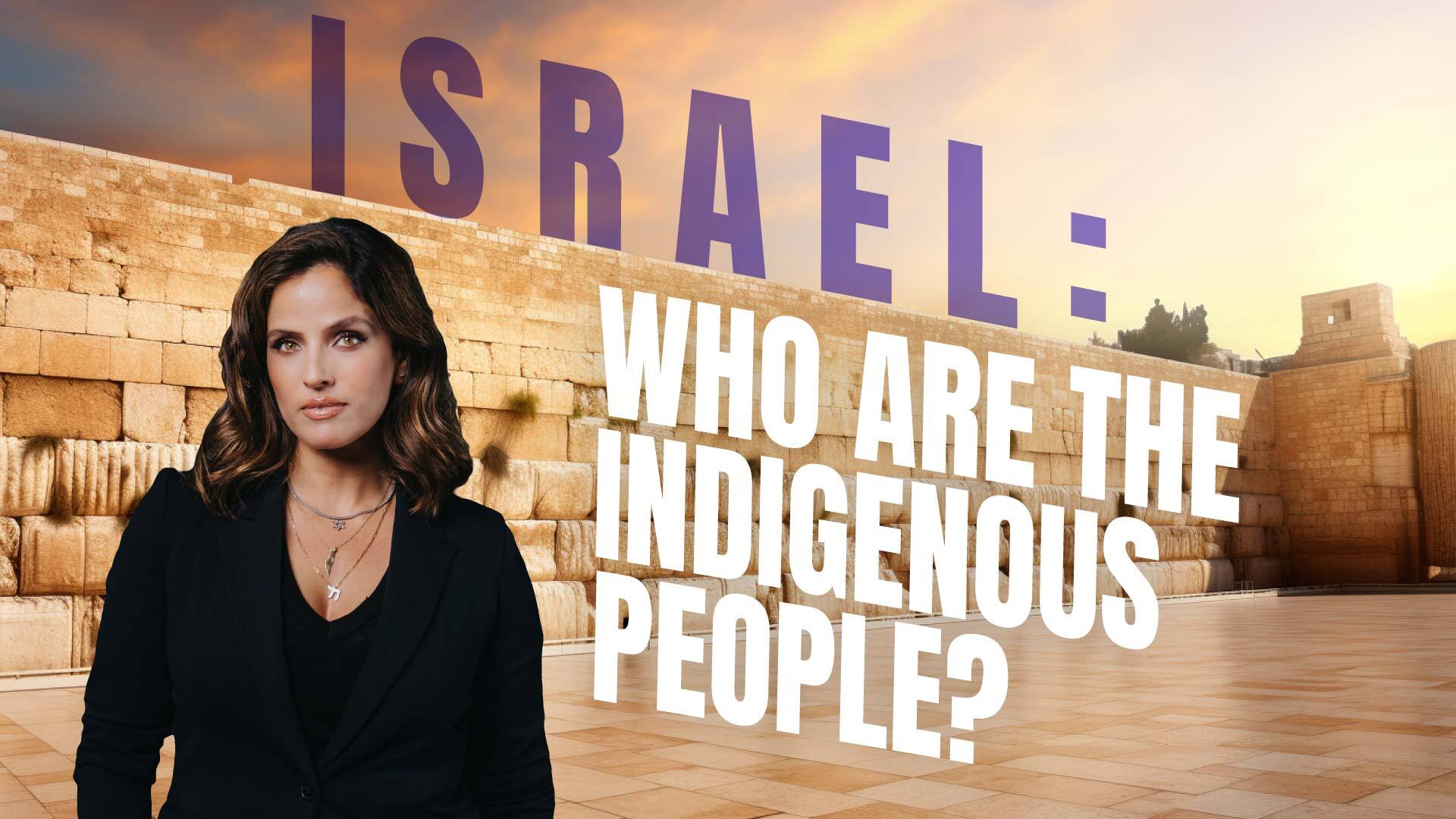
Israel: Who Are the Indigenous People?
The Land of Israel has changed hands many times over the centuries. But it has always been the homeland of one particular people. Noa Tishby, author of Israel: A Simple Guide to the Most Misunderstood Country on Earth, explains.
Hosted By
 Noa Tishby
When we think about indigenous people, we think about their deep roots and longstanding connections to the land they inhabit, often spanning centuries or even millennia.
For example, the Chinese are from China, the Egyptians are from Egypt, and the Indians are from India. But what about the Jews? Well, the Jews are from Judea, the modern-day land of Israel, where Jewish heritage stretches back over 3,000 years.
And like other indigenous people, the connection to the Jewish homeland is an integral part of the Jewish identity. Judaism is not just a religion, but the Jews are also a people with strong ties to the place from which they originated, the ancient land of Israel.
The practice of Judaism is directly connected to that land. It celebrates holidays like the harvest time and has prayers that are tied to the seasons in the Land of Israel.
Seven crop species, including olives, grapes, wheat, and barley, are cherished in Jewish symbolism because they represent Israel, the "Land Flowing with Milk and Honey."
For centuries, Jews have been saying L'Shana Haba'ah B'Yerushalayim, or “Next Year in Jerusalem,” never forgetting their connection to the Land of Israel.
But don’t take just my word for it. Historians and archeologists point to artifacts and historical writings that prove the connection between the land of Israel and the Jewish people.
Hebrew inscriptions have been found on thousands of artifacts dating as far back as the 6th century BC. Hebrew is my mother’s tongue and I can read those inscriptions. In addition to Jewish sources, an Egyptian document dating to approximately 1200 BC mentions a campaign in which an Egyptian ruler says he has defeated Israel.
“Israel is no more,” the document reads, probably the worst prophecy ever made about the Jews, since you know, I’m still here.
The Hebrew Bible is of course much more than a book of history, but there’s a lot of verified history in it. The fact that Jerusalem is mentioned 669 times in its pages confirms that the city is central to the Jewish identity.
Politically, the land of Israel swapped hands for thousands of years, but it was never anything other than a sovereign Jewish state.
Let me say that again: the only sovereign state that ever existed in the Land of Israel— forever—is a Jewish state.
The Jewish people have formed three nation-states in the Land of Israel throughout history. The first was the First Commonwealth, ruled by the House of David, and it lasted for more than four centuries. Israel was united by King David, and Jerusalem was the capital of that Jewish state. The First Temple built by King Solomon was a huge source of Jewish pride.
Then the Babylonians conquered the land, exiling most of the Jewish residents to Babylon. In 539 BC, Persia’s King Cyrus conquered Babylon and issued the Cyrus Decree, allowing the Jews to return to Israel, and many did. They rebuilt the country, including the Second Temple in Jerusalem on the site of the destroyed First Temple. Its Western Wall is still standing and today it is one of the holiest sites of the Jewish people.
The second Jewish state is often referred to as the Second Commonwealth, later called the Kingdom of Judaea, born from the Maccabean revolt against the Greeks. Hello, Hanukkah!
It was a time of independence, but it didn't last. In 70 AD the Romans conquered Jerusalem and burned down the Temple, exiling most of the Jewish population and giving the land a new name—Palestina—in order to disconnect the relationship between the Jewish people and their homeland.
After the destruction of the Second Temple, the land of Israel changed hands many times. From the Romans, the Byzantines, the Caliphate, the Crusaders, the Mamluks, the Ottomans, and the British Empire.
But it wasn't until the 19th century that the Jewish people’s longing to return to their homeland became an existential need because of the rise of murderous antisemitism. A movement was born: Zionism—the Jewish people’s right to have a state again. Zion, by the way, is another name for Jerusalem, mentioned in the Bible over a hundred times. Zionism is a movement for Jewish self-determination in their ancestral land, in a Jewish, not an exclusively Jewish, state.
Initially, locals welcomed new Jewish immigrants, like my great grandparents, who brought prosperity to the land with new cities and agricultural villages, called Kibbutzim. The people they encountered there included the community of Jews who had never left Israel, known as the Old Yishuv.
The Israeli Declaration of Independence ensures equality of social and political rights to all its citizens regardless of religion, race, or sex; guaranteeing freedom of religion, conscience, language, education, and culture; and pledging to safeguard the Holy Places of all religions. Which is what Israel does.
Israel doesn’t deny anyone else’s identity. Of course, there have always been people of non-Jewish identity in the land, including modern Arab Palestinians, who also have ties to the place that Jews celebrate as the Land of Israel and that Christians call the Holy Land.
But if you support indigenous people's rights, you should also be a Zionist, and understand that the Jews are the indigenous people of the Land of Israel, who never really left.
I'm Noa Tishby, author of Israel: A Simple Guide to the Most Misunderstood Country on Earth, for Prager University.