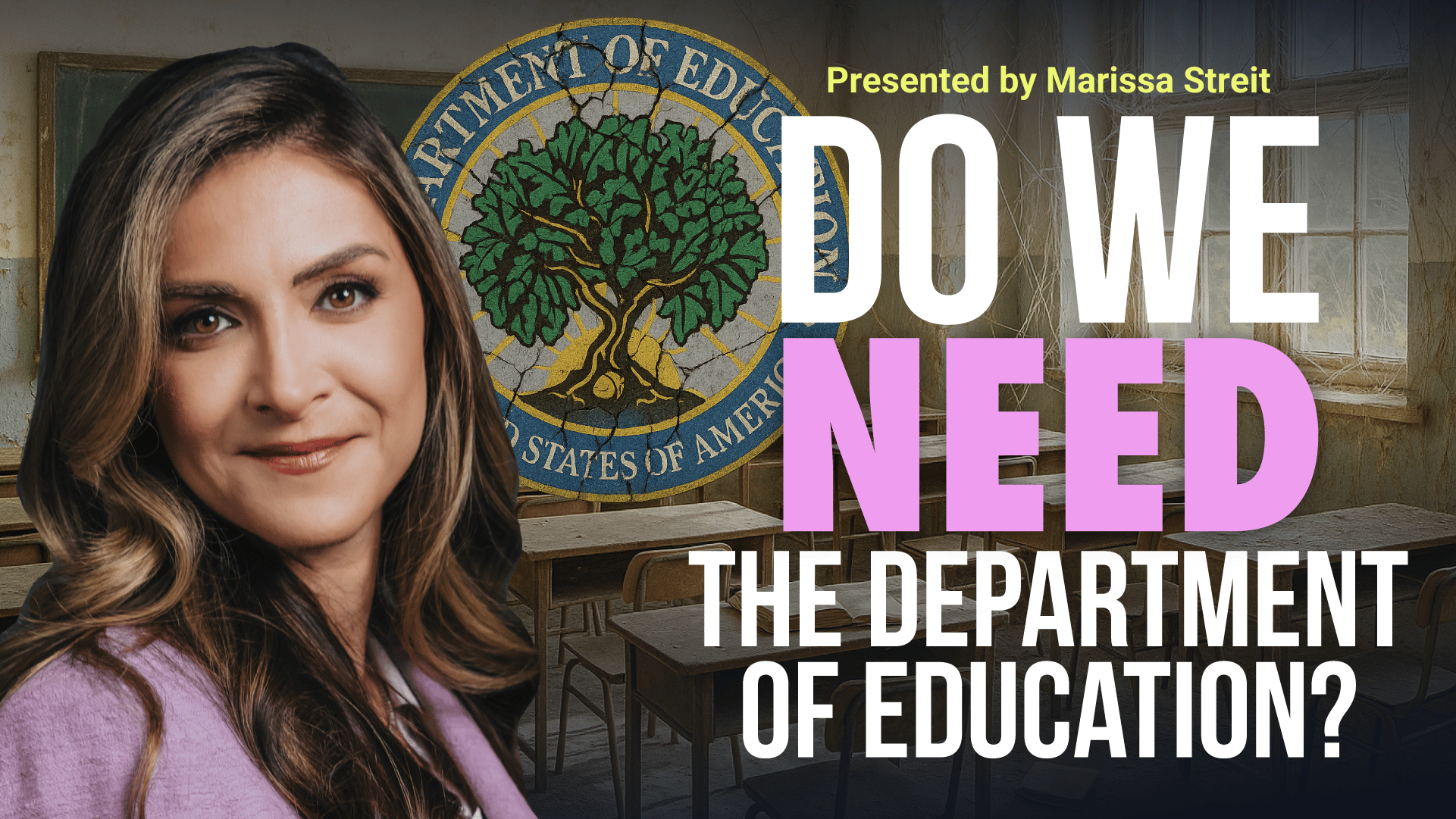
Do We Need the Department of Education?
Before 1979, public education in America was managed at the state and local level—and it was the best in the world. No one can make that claim now. What changed? Marissa Streit, CEO of PragerU, explains what happened and why.
Topics
Hosted By
 Marissa Streit
Do we need a Department of Education?
There’s a good reason to ask this question.
Before 1979, the American public education system, which was almost entirely managed by state and local governments, was widely acknowledged as the best in the world.
Almost a half century later, no one can make that claim.
Right now, the United States is ranked 28th in the world in math and 36th in literacy.
One in four eighth graders lacks a basic proficiency in math.
One in three are not reading at grade level.
Only 13% are proficient in U.S. history.
In certain cities, the numbers are truly appalling. For example, in Chicago, 22 schools didn’t have a single student who was proficient in reading comprehension, and 33 schools didn’t have a single student who was proficient in math.
It’s not a money problem.
According to the most recent numbers, the United States spends $17,000 per student. In Chicago, it’s $29,000.
So what changed? How did our education system go from outstanding to embarrassing?
There are many reasons, of course, from too much screen time to not enough engaged parents.
But we can be confident in one conclusion: the Department of Education hasn’t helped. And the case can be made that it has actually made things worse.
Again, it wasn’t for lack of money. Last year, the department’s budget was $268 billion.
Where’s all that money going, and for what?
To answer that question, we need to go back to 1979.
The president that year was Jimmy Carter. The 1980 election was closing fast and Carter’s chances were not looking good. Beset by the Iran Hostage Crisis, crippling inflation, and gasoline shortages, Carter’s approval ratings had plummeted to a dismal 28 percent.
He needed all the friends he could get. And there was no better friend than the largest labor union in the country, the National Education Association.
It had been agitating for a Department of Education for decades without success. No one besides the teachers’ union thought it was necessary.
But politics is politics. So Carter gave the union what it wanted — a brand new government department and all the perks that go with it: a big budget, a big stick with which to threaten local schools (adopt this program or you won’t get federal dollars) and a big bureaucracy, which they could fill with their loyalists.
One anonymous House Democrat admitted as much at the time: “The idea of an Education Department is really a bad one. But it's NEA's top priority. There are school teachers in every congressional district, and most of us simply don't need the aggravation of taking them on.”
Bad idea or not, what was good for the education of American children took a backseat to Carter’s election prospects. In 1979, he signed the department into law.
From its inception, the Department of Education was a political institution.
It was never intended to help students — it was intended to help the Democratic Party and the unions.
And in that assignment, it gets an A-plus.
Its employees — almost all Democrats — make a very good living and a big chunk of them — over 2,500 — are doing great, making well over $100,000 a year. The department dispenses about $80 billion to schools across the country for educationally questionable initiatives like “teacher development,” “diversity training,” “critical theory studies” and “climate change” awareness.
But most of the money goes to hiring more school administrators, counselors, and their assistants. Reading, writing, and math — the basics — are not, it would seem, a high priority.
The unions get the jobs and the goodies. The Democrats get the votes — the NEA has endorsed every Democratic presidential nominee since Carter — and a vehicle to push their ideas on America’s youth.
These ideas have become more bizarre with each passing year. Here’s one recent example out of dozens I could cite: under the Biden Administration, the department gave Framingham State University $1.3 million to write a textbook — that’s right, $1.3 million for one book — for high school students that “provides a lens for understanding the evolving definition of ‘family’ through socially constructed and ecological theory frameworks.”
Whatever that means.
Name something radical happening in our schools, like boys competing against girls in sports, and the Department of Education has been behind it.
So, do we need a Department of Education? The answer would seem to be: need it for what? If it’s just to distribute money, why do we need another giant bureaucracy to do it? Why not just give the money directly to the states from the Treasury Department?
If the alternative is, let’s not close the department altogether, let’s reform it: how do you reform something into something it was never intended to be?
But if the department really exists as a slush fund for the teachers unions and the educational elite, and as a laboratory for social experimentation on our kids, then there’s only one viable solution: shut it down.
I’m Marissa Streit, for Prager University.