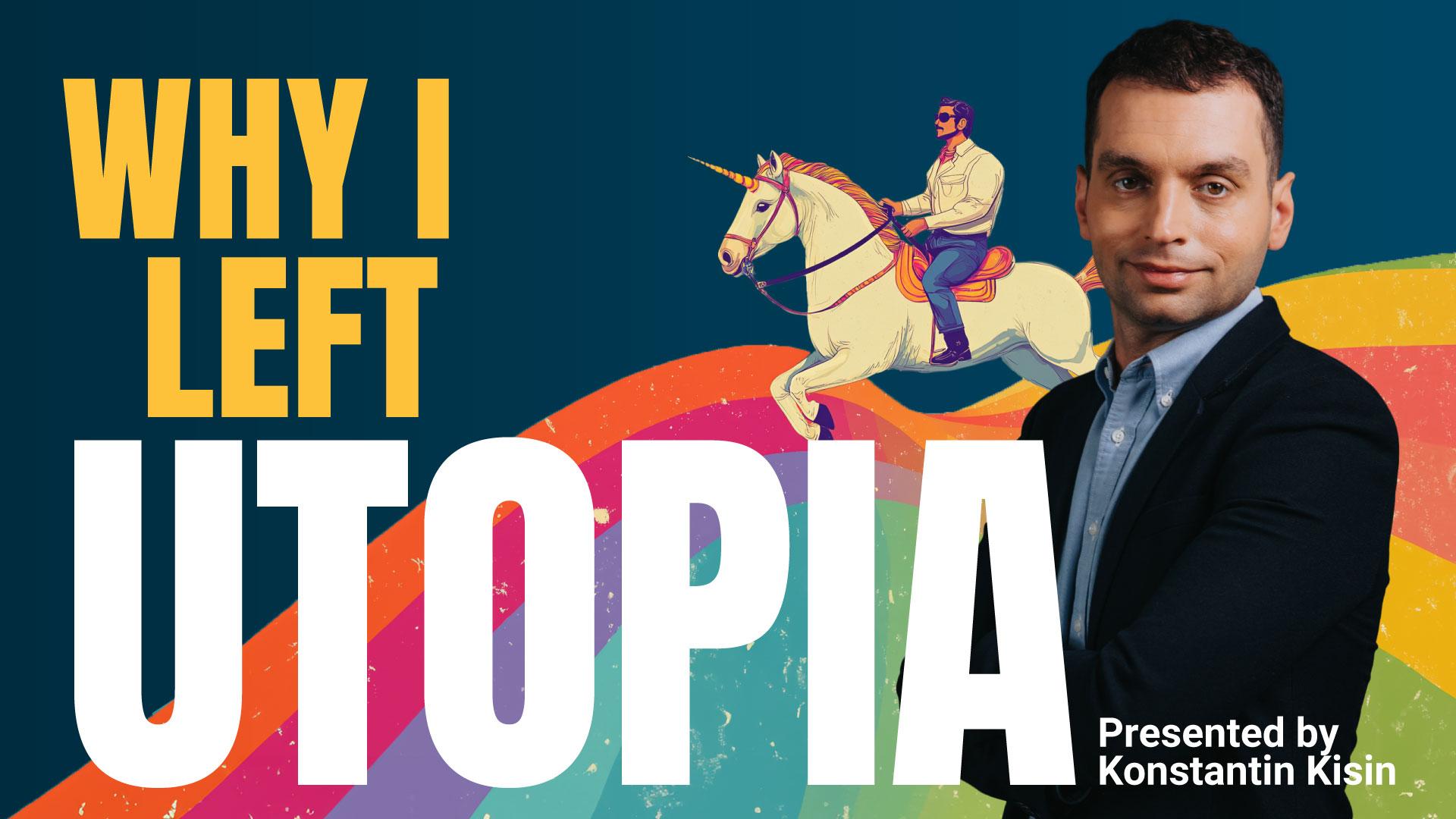
Why I Left Utopia
Konstantin Kisin grew up in a progressive paradise. Childcare, health services, and college were free. No one fought over race, religion, or class. Where was this utopia? And why was he so eager to leave it?
Hosted By
 Konstantin Kisin
I grew up in a progressive paradise.
The gap between the haves and have-nots was practically non-existent.
The literacy rate was almost 100%.
Healthcare was universal and free.
No one fought over race, religion, or class.
Maternity leave was generous. Childcare was free. There were no limits on abortion.
So where was this paradise? No, it wasn’t Norway, Sweden, or Finland.
It was the Soviet Union.
Everything I just described was true, and yet, life in the Union of Soviet Socialist Republics, the USSR, was a living hell.
Yes, income inequality barely existed, but that was because everyone was equally poor. Appliances, consumer products, and fresh food were scarce. If you wanted a car, good luck. You’d be on a waiting list for ten years.
Yes, women were “emancipated.” But they spent most of their time waiting in line for hours for food to feed their children. Disposable diapers were unheard of, as were vacuum cleaners. A dishwasher? Are you kidding?
Healthcare was free—in theory. But you could only get decent and timely treatment if you had influence, connections, and cash to pay bribes.
Everyone was educated, but there were strings attached: if you went to college, the government decided what your career would be and where you would live.
Racial and ethnic strife was limited, yes. But only because the government ruled by fear and terror, imprisoning millions of people—“enemies of the state”—in a vast network of concentration camps known as gulags.
These “enemies” included my great-grandparents, who met in one of these gulags. Every morning, guards would randomly select three prisoners and throw them into the icy waters of a nearby lake, to drown in front of the whole camp.
New York Times reporter Walter Duranty, a Stalin apologist, once wrote, ”You can’t make an omelet without breaking eggs.”
But in the Soviet Union, there were no omelets, only broken lives, broken dreams, broken bodies.
It may be hard to believe this now, but for most of its existence, the Soviet Union was the envy of many progressives, academics, and celebrities.
America should be more like Communist Russia, they said. More equal, more equitable, more emancipated.
But this view was born of sheer ignorance. The USSR had no virtues worth emulating. When gullible Westerners visited, they saw what the regime wanted them to see, literally: movie sets of a workers’ paradise. There was even a phrase for it: a Potemkin village. There was also a phrase for the Westerners who were fooled by this facade: useful idiots.
Of course, no one in the Soviet Union was fooled. They weren’t “living the dream,” they were living the nightmare.
Having been raised in that “workers' paradise,” I am sensitive to any promises of utopia. When I hear progressives talking about “eradicating inequality,” “smashing the patriarchy,” and righting the wrongs of “settler colonialism”—all echoes from the Soviet era—my blood runs cold. These promises might sound idealistic but they’re anything but.
It seems to be a sad fact of human nature that people who don’t realize how good they have it are vulnerable to demagogues who promise to tear it all down and build a “better tomorrow.”
That’s exactly what Lenin promised before imposing tyranny, poverty, and terror; exactly what Mao promised before imposing tyranny, poverty, and terror; exactly what Castro promised before imposing tyranny, poverty, and terror.
Think it can’t happen in the UK or the US?
Maybe not. Maybe our institutions are so strong they can fight off any attempts to undermine them. I certainly hope so.
Then again, do you think the Russians knew where the Bolsheviks were leading them? Do you think the Cambodians knew where Pol Pot was leading them? Venezuelans where Hugo Chavez was leading them?
I’ll tell you where: to that “better tomorrow.” And just in case you think those Russians, Cambodians, and Venezuelans were just naïve, the New York Times thought the same thing in each case—that they were headed to a “better tomorrow.”
Yes, in a perfect world, everything would be free and everyone would follow their bliss while riding unicorns to the end of the rainbow.
But we do not live in a perfect world and we never will. Every sensible person knows that.
There’s only this world with all its pain, injustice, and disappointment. We must deal with reality as we find it, not as we wish it to be. The irony is that the world we have fashioned in the West is close to near-perfect when compared to the “better tomorrow” progressives keep promising us.
That’s the lesson I’ve learned from experience. It’s a lesson learned by everyone who’s lived in one of these “paradises”.
And now, hopefully, you’ve learned it from me.
I’m Konstantin Kisin, co-host of the TRIGGERnometry podcast, for Prager University.