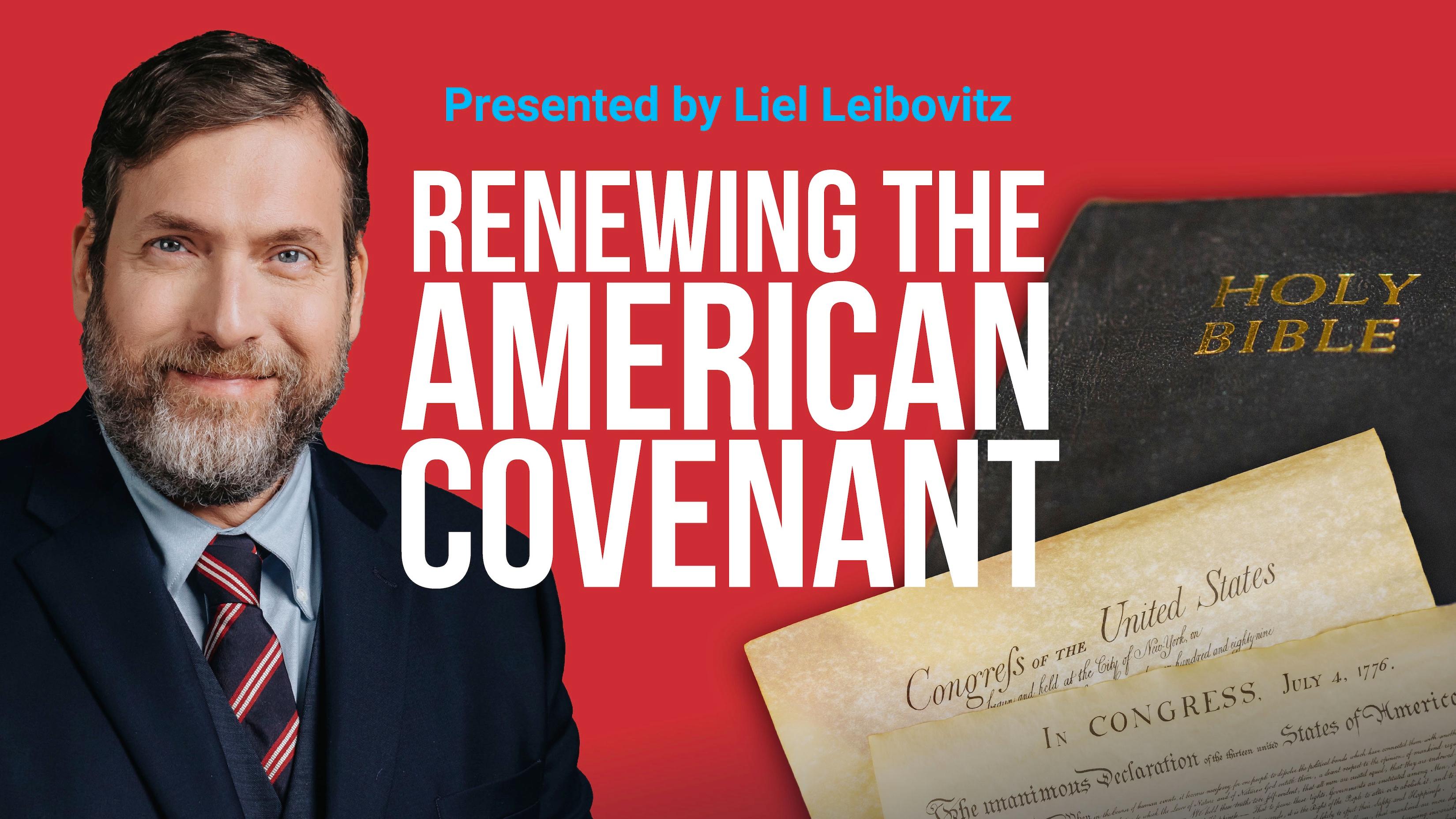
Renewing the American Covenant
What is the American covenant? How is it related to the Judeo-Christian concept of freedom? And why does this covenant make America different from other nations? Biblical scholar and social commentator Liel Leibovitz explains why the answers to these questions will determine the future of the United States.
Hosted By
 Liel Leibovitz
America, it has often been said, is not so much a place but an idea.
What does this mean?
The language of the Bible, as so often happens, offers us an excellent clue.
In Hebrew, the United States of America is called Artzot HaBrit, or the States of the Covenant.
A covenant is much different than a contract. A contract stipulates every imaginable condition and covers every loophole because it has no theory of change; it wants to guarantee a very specific outcome. The shipment is delivered; the house is sold.
A covenant, on the other hand, is all about change—you enter into it in order to grow and become the best version of yourself. It’s a leap of faith.
Just ask the Biblical prophet Abraham. God selects this ordinary man to bring His name into the world not because of who he is, but because of who he is capable of becoming.
Following in his footsteps, his descendants, the Jews, sought to remain true to the covenant. They quickly realized that the strange, terrifying, and marvelous thing about covenants is that they must be renewed. No renewal looks the same. Each comes with its own set of obstacles and opportunities. Each demands that we, like faithful Abe, ask ourselves what it is that we believe and what it is that God is calling us to do.
Which brings us back to America.
As the Hebrew name for America suggests, we are a covenantal nation.
We fought a war for our freedom in 1775 and enshrined that freedom in the US Constitution in 1787.
We renewed the covenant in 1861, when we took up arms against those who argued that liberty for some requires shackles for others.
We did it again a century later, when the Civil Rights Movement sought to make us adhere to our founding principles.
And now, we are heading toward another renewal of the covenant.
It will be a fierce contest between two very different visions of America. It’s raging right now.
On one side are those who believe in covenantal America. Following in Abraham’s footsteps, these Americans believe in rising to the occasion. They want to do it by defending the verities that spring from our biblical tradition.
They are builders—of families, of churches and synagogues, of new institutions and new communities — dedicated to values tested by experience and time. They are not sentimentalists. They understand that the America they’re called to renew will not look like the one that came before.
Those Americans on the other side take a different approach. They block bridges and occupy public spaces. According to them, America is a depressing place, founded by one race to exploit other races, and that this base motive remains its unerasable sin.
Abraham was no stranger to foes who trafficked in lies and deception; nor was another Abraham — Abraham Lincoln. Both Abrahams understood the power of walking with God. “Without the assistance of the Divine Being…” Lincoln said on the eve of the Civil War, “I cannot succeed. With that assistance, I cannot fail.”
Honest Abe wasn’t grandstanding. He understood the power of covenants. They are great engines, tremendous sources of renewable spiritual and political energy.
If you believe that you have a responsibility to uphold worthy traditions and preserve what is good and just in our national inheritance, you can meet every challenge. If, on the other hand, you are animated by a sense of entitlement and resentment or you welcome wrath unchecked by law or love or loyalty, then you are a match in search of something to burn.
That contrast—the ambition to renew versus anger that destroys—defines our current civil divide.
One side makes a case, rooted in truth, in Scripture, in American history, in observable biological reality, in essential human psychology. The other, like Abraham’s adversaries, bows to flimsy idols, feeds its lust for domination, and believes that everything is permitted.
For short and terrible periods of time an abandonment of reason can feel thrilling: Men can become women! Social justice means looting the Prada store! Let’s throw soup at a work of art to show our love for Mother Earth! But the thrill doesn’t last. It loses steam quickly, producing nothing but broken cities and broken spirits.
While covenant renewals are often rocky, they’re ultimately energizing and ennobling to those who keep the faith.
Let’s find our inner Abraham, and, like him, say — Hineni, here I am, committed, ready for the challenge of renewing America. It’s hard to imagine a more worthy cause.
I’m Liel Leibovitz, editor-at-large for Tablet Magazine and columnist for First Things, for Prager University.