Get credit for watching this video with PragerU Premium. Start your streak.
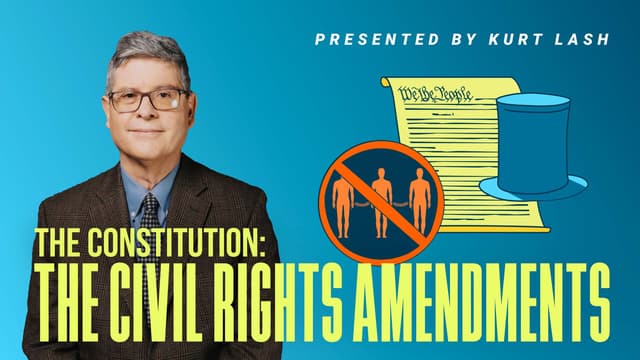
The Constitution: The Civil Rights Amendments
After the Civil War ended in 1865, Americans began the business of reconstructing their country, and along with it, their Constitution. Kurt Lash, Professor of Law at the University of Richmond, analyzes the three amendments that ushered in a new era of freedom for all.
Watch more from PragerU’s Understanding the Constitution: A 10-Part Series.
Topics
Hosted By
 Kurt Lash
As Americans began the business of reconstructing their country after a bloody civil war, they also reconstructed their Constitution. That was the purpose of the 13th, 14th, and 15th amendments.
The 13th amendment abolished slavery.
The 14th amendment enhanced the civil rights of all citizens.
And the 15th amendment guaranteed the right to vote regardless of race.
Together, these three amendments, known as the Reconstruction Amendments, declared a new birth of freedom in the United States.
In January 1863, at the height of the Civil War, President Abraham Lincoln issued the Emancipation Proclamation. That Proclamation declared free any person held as a slave in the rebel states. But ending slavery would require much more than a wartime executive order.
First, the Union would have to win the war — that wasn’t certain in 1863 — and second, Lincoln would have to persuade the American people to amend the Constitution to ban slavery forever.
In January 1865, with Lincoln’s encouragement, Congress passed the Thirteenth Amendment. The amendment proclaimed, “Neither slavery nor involuntary servitude…shall exist within the United States, or any place subject to their jurisdiction.”
On April 9th of that year, Confederate general Robert E. Lee surrendered to Union general Ulysses S. Grant. The Civil War was finally over. Less than a week later, Abraham Lincoln was dead, felled by an assassin’s bullet. But his ambition to free the slaves lived on. On December 6th, 1865, the American people ratified the Thirteenth Amendment. Slavery could no longer find sanctuary in the Constitution.
Although the now-former slaves had attained freedom, that didn’t mean they had attained equality. Taking advantage of the chaos following Lincoln’s assassination, the southern states passed the infamous “Black Codes” — laws and local ordinances which denied blacks basic rights such as free speech, the right to bear arms, and the right to peaceably assemble.
You might well ask, weren’t blacks — now that they were free — protected like every other free American by the Bill of Rights? No — not according to the Supreme Court. In 1833, the Court had ruled in Barron v. Baltimore that the first ten amendments applied only to the federal government, and not to the states.
To correct this injustice, a new amendment would be required. This became the Fourteenth Amendment, ratified on July 9th, 1868.
“No State,” it said, “shall make or enforce any law which shall abridge the privileges or immunities of citizens of the United States; nor shall any State deprive any person of life, liberty, or property, without due process of law; nor deny to any person within its jurisdiction the equal protection of the laws.”
In other words, the Bill of Rights now applied to state governments as well as to the federal government.
Together, these provisions invalidated the Black Codes and guaranteed the rights of American citizenship to every person in the country, white or black.
Yet even this was not enough.
Black Americans had fought and died alongside white Union soldiers. Despite their sacrifice, in most states, blacks were still denied the right to vote.
To black civil rights leaders like Frederick Douglass, this was unacceptable. According to Douglass, the “arm of the federal government is long, but it is far too short to protect the rights of individuals in the interior of distant states. They must have the power [of the elective franchise] to protect themselves…”
In February 1869, Congress passed the Fifteenth Amendment to the Constitution. The amendment declared that “the right of citizens of the United States to vote shall not be denied or abridged…on account of race, color or previous condition of servitude.”
On February 3, 1870, the new amendment was ratified. To now-President Ulysses S. Grant, erasing the color bar at the ballot box was “a measure of grander importance than any other one act [since] the foundation of our free government.”
Constitutional Reconstruction was now complete.
Slavery was abolished, the basic rights of life, liberty, and property protected, and political power extended to every citizen in the country regardless of race. The basic structure of the Constitution remained the same, but the rights of American citizens were dramatically expanded.
These three amendments forever changed the meaning of American freedom.
As Frederick Douglass declared upon the adoption of the Fifteenth Amendment, “Henceforth we live in a new world, breathe a new atmosphere, have a new earth beneath and a new sky above us.”
Douglass’s enthusiasm was warranted, but sadly premature. There was much more work to be done before black Americans could enjoy full equality.
The 13th, 14th, and 15th Amendments, however, made that equality inevitable.
I’m Kurt Lash, Professor of Law at the University of Richmond, for Prager University.