Get credit for watching this video with PragerU Premium. Start your streak.
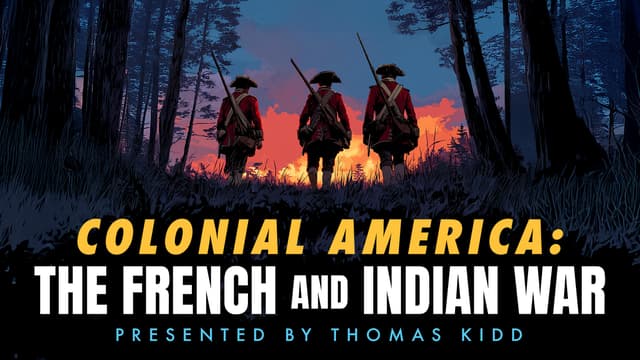
Colonial America: The French and Indian War
Before the American Revolution came the French and Indian War—a conflict that redrew maps, ignited colonial unrest, and brought to the world stage a young man who would change the course of history. Thomas Kidd, author of American History Volumes 1 and 2, explains how this war set the stage for America’s fight for independence.
Topics
Hosted By
 Thomas Kidd
"The volley fired by a young Virginian in the backwoods of America set the world on fire."
That was the observation of Horace Walpole. The noted 18th-century English historian knew what he was talking about. As a member of Parliament, he had a keen grasp of the moment. The conflict he was describing was the French and Indian War, known in Europe as the Seven Years’ War, the first true world war in history. Spanning the years 1756 to 1763, the contest was fought, not only in North America, but also in Europe, Africa, and Asia. Its outcome reshaped the global order.
And who was that young Virginian who caused so much trouble?
His name was George Washington. Yes, that George Washington. The Father of our Country was also the progenitor of the war that led directly to the American Revolution.
In 1754, a 22-year-old Washington was sent by the royal governor of Virginia, Robert Dinwiddie, to challenge French claims to the Ohio River Valley.
Along the way, he ran into a detachment of French soldiers. When they reached for their guns, Washington’s men opened fire. The French surrendered, but things quickly got out of control. Before it was over, the French commander, Jumonville, was dead, tomahawked by Washington’s Indian scout, Tanaghrisson.
The French took it badly. England had been challenging their preeminence in North America for some time. Washington provided the French the excuse they needed to claim supremacy on the continent.
The French military had the advantage. They had fortified positions from Canada to the Great Lakes to the Mississippi Delta and controlled much more land than the British.
The English colonists, by contrast, were confined to a relatively narrow corridor along the east coast. They felt penned in. Certainly, that’s how Washington felt. An ambitious young man, he and his fellow colonists dreamed of extending British America into the frontier, which at that moment was under French and Indian control.
This ambition separated the two European empires. The French were preoccupied with their fur trading network with the Indians, but the English colonists were preoccupied with setting down roots.
Here, demography became destiny.
By the mid-1750s, there were 1.5 million English colonists in North America and just 70,000 Frenchmen.
Britain also had another major advantage: highly competent leadership, mainly in the person of its parliamentary leader and then prime minister, William Pitt. This visionary statesman was the true architect of the British Empire. His strategy in North America was straightforward: if the British could evict the French from their major forts, there was nothing for the French to fall back on.
After initial setbacks, in 1758 the British overran the French compound at the fork of three rivers — the Allegheny, Monongahela, and Ohio — and renamed it Pittsburgh in honor of their prime minister.
This set the stage for a decisive encounter at Quebec in 1759.
Quebec was the capital of French Canada, and one of the most well-defended cities on the continent. British commander James Wolfe devised an ingenious strategy in which he sailed his troops under cover of darkness past Quebec’s cannons, which guarded the St. Lawrence River.
His men then surprised the French by scaling the “impregnable” high cliffs bordering the west end of the city. There, the British and French armies collided. The British prevailed, the French never recovering from the surprise attack. General Wolfe died during the battle but attained immortality as the “Conqueror of Quebec.”
After the fall of the city, the French strongholds collapsed one after another. Pitt’s strategy was vindicated.
The Treaty of Paris in 1763 left the British as the dominant power in the New World. The colonists were delighted with the outcome. The idea of being under French control was a fate no English colonist could bear to contemplate.
Ironically, as it turned out, being under the control of the Mother Country proved to be equally unbearable. Until the French and Indian War, the colonies were virtually self-governing. Each colony had its own legislature and passed its own local laws. London ruled, to the extent it ruled at all, with a light hand. The war, however, had been very expensive. Someone had to pay for it. To Parliament, that someone was the colonists. After all, the war was fought for them.
In 1764, the British introduced a new tax and tariff program, enforcing duties on sugar, molasses, and coffee. This was followed by the Stamp Act in 1765, which imposed more taxes, this time on various printed material, like newspapers.
This was too much for the colonists. How could they be subject to taxes without having the benefit of representation in Parliament? Wasn’t this the very definition of tyranny? “No taxation without representation” perfectly captured the spirit of the protest. The spark that would lead to the American Revolution had been lit.
That revolution would be led by the same Virginia colonel who started the French and Indian War.
I’m Thomas Kidd, author of American History Volumes 1 and 2, for Prager University.