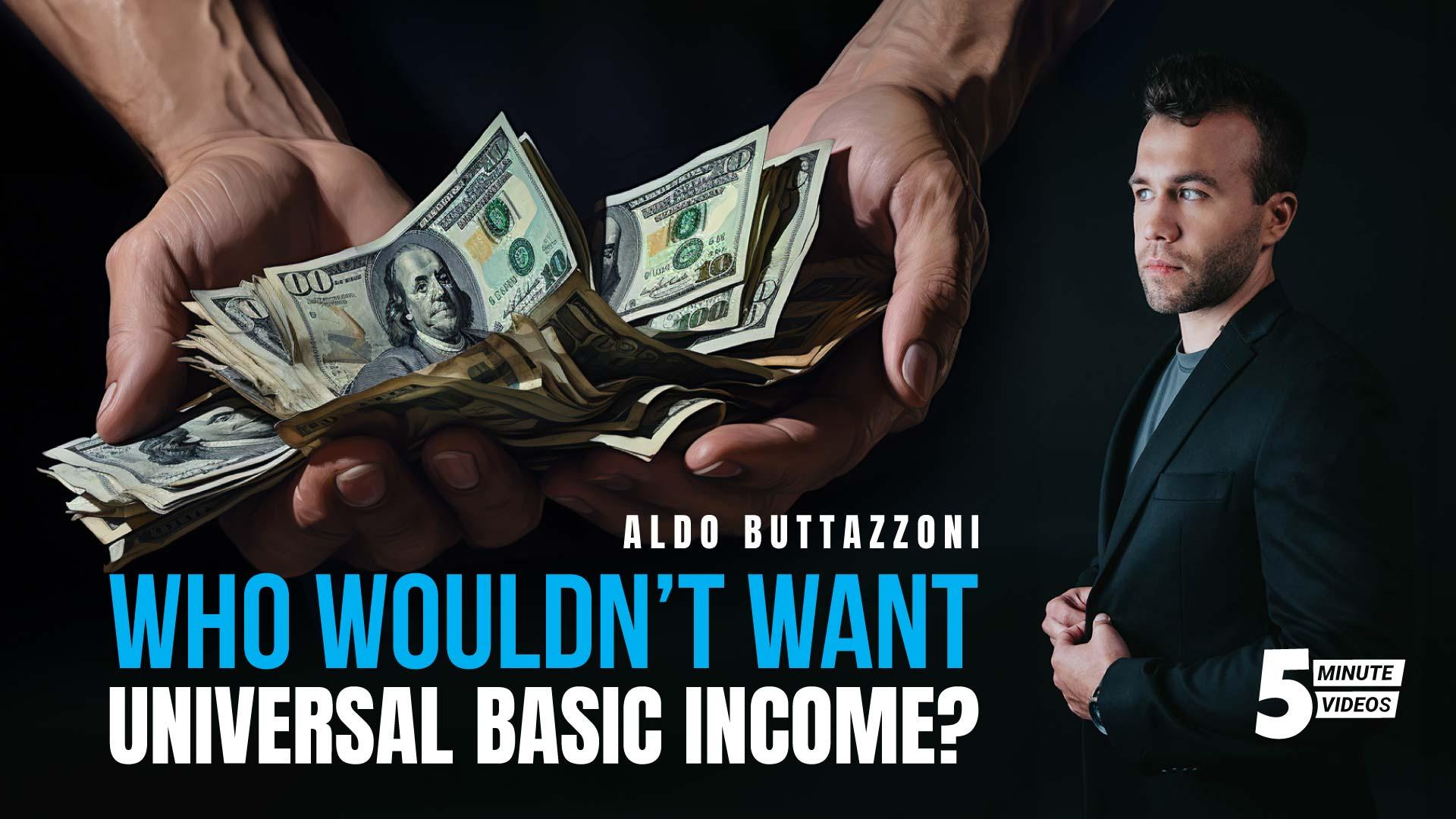
Who Wouldn't Want Universal Basic Income?
If the government gave people enough money to take care of their basic needs, could we eliminate poverty? Proponents of Universal Basic Income think so. Are they right? Would it really be that simple? Aldo Buttazzoni lays out the pros and cons of UBI.
Hosted By
 Aldo Buttazzoni
How does this sound?
$1,000 a month. No questions asked. You don’t even have to buy a lottery ticket.
All you have to do… is breathe.
Too good to be true?
Well, that depends on your view of UBI or Universal Basic Income.
UBI is an idea that has been kicking around for a while.
The concept goes like this: give people enough money to take care of their basic needs and we can eliminate poverty. In other words, we establish a floor below which no one will fall. Every citizen is provided for.
Appealing, no? After all, we live in the wealthiest country on earth and yet we have people living in the street. It’s a moral travesty. UBI solves it.
Of course, there’s the small question of who is going to pay for it.
Giving $1,000 a month to every American citizen (that’s the Universal part of UBI) would cost something like three trillion dollars a year.
That would make it by far the most expensive item in the federal budget. Of course, everyone’s taxes would have to go up to pay for this gigantic new expense.
How much?
David Henderson, an economist at the Hoover Institution calculates that to pay for UBI “the federal government would have to increase taxes by 74 percent.”
Venture investor and former Democratic presidential candidate Andrew Yang, a vocal proponent of UBI, says we can fund UBI with a 10% value-added tax, which means that everything you buy will have a 10% surcharge built in. Would Americans agree to such a big tax on top of all the taxes they already pay? Seems unlikely.
The chances, then, that we could raise the money in taxes—by any method—to pay for the program are almost zero. That means the government would have to make up the difference; that is, go deeper into debt, which is just another way of saying “print more money.” The inflation this would almost certainly cause would raise prices and make the dollars people were getting from UBI worth steadily less, therefore defeating the purpose of the entire enterprise.
Of course, some proponents say that UBI would make many existing government assistance programs—like food stamps and Medicaid—unnecessary, and that would save a lot of money. Okay, but as generous as a $1,000 monthly giveaway might seem, do you really think it would cover food, healthcare, and other living expenses? Let alone your iPhone?
For the sake of argument, let’s say money or inflation were not big obstacles. Would it be a good idea then?
UBI supporters would, of course, say yes. When people are free from survival concerns, they contend, they are free to pursue their true interests. Instead of merely making money, they would have time for creative writing or taking long walks or whatever interests them.
And here's another plus: people would only have to take a job that they find fulfilling because they wouldn’t have to worry about the basics.
But, given what we know of human nature, another scenario seems much more likely: people would spend a lot more time on the couch playing video games or swiping their way through TikTok.
And then there’s the dignity that comes from work, from making your own way in the world, developing habits of personal responsibility. Do we care about that? Or is that just a remnant of an outdated way of looking at life?
And what if UBI flat-out just doesn’t work? Does anyone really think $1,000 a month is what separates a homeless drug addict from a productive life? Is a $1,000 handout going to give someone purpose or meaning?
Furthermore, wouldn’t UBI stoke resentment? Nobody likes to toil so that their neighbor can play. That’s hardly a recipe for social cohesion.
There’s something else to consider when discussing the downside of UBI. Once you give people things for “free,” it’s very hard to take “free” away from them. That’s pretty much a universal law.
It’s also a universal law that government programs expand, taking on a life of their own. Maybe $1,000 a month will be good enough to start, but how long before it’s not enough?
Do we have examples where UBI has been tried? The answer is yes. Not in its $1,000 a month form, but in more limited ways.
Finland tried a UBI program from January 2017 until December 2018 and then gave up. Two thousand unemployed Finns got a monthly payment of $640. There were no employment gains above the expected rate, but many participants said they felt happier and less stressed.
Duh. Free money tends to have that effect.
A few American cities have also tried limited forms of UBI. Some of these programs are ongoing.
Stockton, CA gave a few hundred people $500 a month. The city government reported that the participants really liked it. And why wouldn’t they? What did anyone think they’d say, “No, stop giving me money. I don’t want it anymore.”
UBI might sound compassionate.
But it’s really not, because it doesn’t free people; it enslaves them—to the government.
I’m Aldo Buttazzoni for Prager University.