Minimum Wage Cost Me My Job
What happens when politicians decide they are in a better position than business owners to know how much workers should be paid? We don't have to guess. Cities like Seattle and New York have already done so with their $15/hour minimum wage mandates. Simone Barron, a lifelong restaurant worker, recounts how "helping" her impacted her wallet, her career, and her life.
When including tips, Ms. Barron would make on average _____________________________ on a typical night prior to the wage hike.
$5 to $10 dollars an hour$15 to $25 dollars an hour$25 to $50 dollars an hour$50 to $75 dollars an hourBy what percentage did the Seattle City Council raise the minimum wage in 2015?
28%38%48%58%Most restaurants have large profit margins.
TrueFalseWhat did Seattle restaurant owners do in response to the 2015 wage hike?
raised pricesre-worked their menuscreated new compensation modelsall of the aboveInstead of the 18-20% or more Ms. Barron used to earn on any check, she now earns a flat _____________ on every check.
4%14%24%34%
- Past increases in the minimum wage have made some lower and middle-class people poorer and led to an increase in the overall poverty rate.
Past increases in the minimum wage made some lower and middle-class people poorer and led to an increase in the overall poverty rate.
View sourceThe large majority of data-driven economic studies demonstrate that significant increases in the minimum wage also increase unemployment. When wages increase, people are often willing to work even though employers can’t afford to hire them, leading to a demand-side inequality causing higher unemployment.
View sourceThat scenario played out in Seattle after its 2015 minimum wage increase.
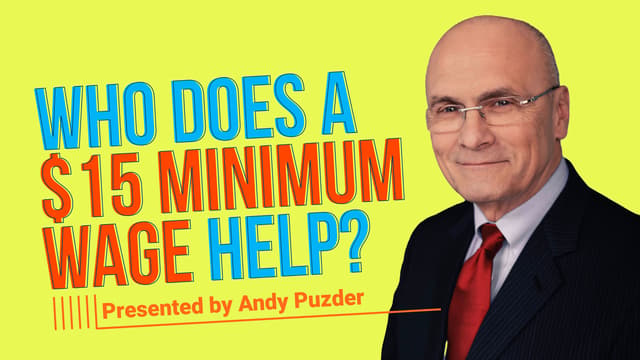
View sourceRelated video: “Who Does a $15 Minimum Wage Help?” - Andy Puzder
View source- A high minimum wage makes many employees simply too expensive to employ, or forces employers to cut their hours.
Minimum wage increases reduce the profit margin that all employees contribute to a business. Increasing the minimum wage makes many employees too expensive to employ or reduce the hours they are employed, which is also a pay reduction.
View sourceA 2015 study by the Manhattan Institute estimated that a $15 minimum wage would kill over 6 million jobs.
View sourceWATCH: Scholar James Sherk on the minimum wage.
View sourceReading: “The Negative Effects of the Minimum Wage” – Mark Wilson
View source- The people most hurt by the minimum wage are those who most need entry-level jobs—young and low-skilled Americans.
During the Great Recession from 2006 to 2009, increases in the minimum wage accounted for 43% of unemployment among young and low-skilled workers.
View sourceThe young are the most vulnerable because they usually have the fewest job skills. Research found that youth (under age 25) unemployment rose 2.8% after the federal minimum wage hike from $5.15 to $725 between 2007 and 2009. The result is incentivizing more people to drop out of school, hurting their long-term earning potential.
View sourceRelated reading: “Sense and Non-Sense on the Minimum Wage” – Cato Institute
View source- A mandated higher minimum wage can hurt those who already have jobs through reduction in benefits, hours and training.
For those with jobs, increases in minimum wage often lead to the reduction in benefits and employee hours.
View sourceAn increase in the minimum wage can also “reduce employer-offered on-the-job training because the tutoring is financed out of worker wages.”
View sourceRelated video: “How Does The Minimum Wage Work?”
View sourceRelated Reading: “Minimum Wage, Maximum Politics” – Andy
View source- Minimum wage increases hurt low-skilled and young workers the most by making entry-level and part-time jobs harder to come by.
Entry-level jobs provide work experiences that form the basis for future employment opportunities.
View sourceEntry-level and part-time jobs provide a valuable opportunity to learn new skills that form a foundation for future entrepreneurs.
View sourceHalf of all people earning minimum wage are under the age of 24.
View sourceJames Sherk on minimum wage jobs: “Two-thirds of minimum-wage workers make above the minimum wage a year later. This happens because most minimum-wage jobs are entry-level positions. They teach unskilled and inexperienced workers basic employment skills. Without these skills, they cannot qualify for higher-paying jobs. As they acquire these skills, they become more productive and can command higher pay.”
View sourceRelated video: “How the Minimum Wage Hurts Young People”
View source- Significantly increasing the minimum wage will force some businesses to close their doors.
Most businesses that pay minimum wage are small “mom and pop” firms with low profit margins. The typical fast food restaurant only earns 3-6 cents of profit per dollar of sales. These firms can only afford to pay higher wages by raising prices for consumers.
View sourceAfter San Francisco increased the minimum wage to $15 in 2015, AQ, a rising star among restaurants in the city, saw profits reduced from 8.5% in 2012 to 1.5%. The largest factor contributing to the closing of this well-known restaurant was “paying health care and labor costs for its employees.”
View sourceMinimum wage increases in New York City in 2017 likewise resulted in closed businesses.
View sourceWATCH: John Stossel on the minimum wage
View sourceRelated Reading: “Minimum Wage, Maximum Politics” – Andy Puzder
View source- A person’s wages should be determined by what they can offer employers and what employers need—not by the whims of the government.
The same principles of supply and demand that control the market place, also naturally apply to the job market and wages.
View sourceWhen the government forces increases in wages without the market improving, the result is employers hiring fewer people and/or cutting hours.
View sourceRelated video: “How the Minimum Wage Hurts People”
View source- A higher minimum wage hurts the poor more than anyone else.
Because a higher minimum wage increases unemployment among low-skilled workers, it adversely affects the poor by making fewer jobs available for them. Past increases in the minimum wage made some lower and middle-class people poorer and led to an increase in the overall poverty rate.
View sourceStudies have found that the of individual who receive a minimum wage do not live in low-income households.
View sourceRelated video: “Does the Minimum Wage Prevent Poverty?”
View source
Like the fair-minded Progressive that I was, I thought a $15 minimum wage was an absolute good.
Then, I had a head-on collision with reality.
It’s a funny thing about reality. It just is. You can’t wish it away.
So, here is my cautionary tale.
For over three decades I had a good job working as a server. I have worked in some amazing, award-winning restaurants in Seattle.
I enjoyed the work. Met wonderful people. And I was making really good money.
I wasn’t making much, per hour—that’s true—but in my business, the magic is in tips. On a typical night, I would make on average $25 to $50 an hour.
Believe me, I earned it. I took pride in my work. I wanted every dining experience to be a memorable one for my guests.
I also loved my job for THIS reason: I had flexibility. I could plan my work schedule. That was very important to me because I had a growing son. It was a good life.
Then, in 2015, the Seattle City Council raised the minimum wage from $9.47 to $15 an hour—a 58 percent hike!
Great for the working stiff, right?
Well, hang on, because here comes Mr. Reality.
The business owner, the person who signs the checks, has to find a way to pay for this massive new expense. For Walmart or Microsoft or a large restaurant chain, this might not be a problem. For a local restaurant owner, it’s a nightmare.
Contrary to popular opinion, most restaurants don’t have big profit margins. In fact, most are razor thin.
Seattle restaurant owners, faced with this shock to their bottom line, raised prices, reworked their menus and created new compensation models.
Some did away with tips altogether, substituting a flat service charge as a way of navigating the climbing wage. That change in the tipping model caused a dent in my pocketbook. The rise in the wage did not cover the loss of the tips.
And, of course, they cut back on employee hours and support staff, too.
But for many establishments, none of these cost-saving measures worked. Restaurants, some that had been in business for decades, many family-owned, closed — including the ones I worked for.
Good servers don’t grow on trees. I was able to score an interview at another amazing restaurant.
Then, before I could even confirm the interview, that one closed, too. Same reason. The $15 minimum wage cut their profits down to nothing.
So, let me add this up for you.
I make a lot less money now than I did before Seattle decided to do what was supposedly in my best interest.
I used to be able to pay my bills as they came due.
Now it’s a juggling act.
I used to have enough money to support my son’s extra-curricular activities.
Now I often just say no.
Before the minimum wage increase, I had one job and worked four days a week.
After the wage hike, I had two jobs and worked six.
With my skills and a tipping culture, I used to average 18 to 20 percent or more on any check. Now, instead of tips, I get a flat 14 percent, part of the 20 percent service charge the restaurant owner tacks on the bill. I still pride myself in providing good service, but the incentive to go the extra mile is gone. There is no way to maximize my income.
And what’s Seattle’s answer to my problem? To raise the minimum wage again!
The progressive idea is that you should be able to make a "fair wage". But if you have no job or are working more for less, how is that fair?
How is it fair to my friend, who worked his way up from busboy to sommelier (the fancy name for the person who manages a restaurant’s wine list)? He lost his job when his restaurant closed due to the minimum wage increase. Or, my former boss, who went from a cook to an owner, and couldn’t survive the double blow of the minimum wage law and the coronavirus?
And it’s not just a “Seattle problem.”
In New York City, raising the minimum wage to $15 an hour pushed the restaurant industry into a recession. To stay afloat, seventy-five percent of owners reduced employee hours, and forty-seven percent eliminated jobs. San Francisco is in the same boat.
Mandating minimum wage laws might be a winner for progressive politicians and ivory tower economists, but it's a loser for those of us who have to live with the consequences.
Unless fair-minded people speak out, those consequences only figure to get worse as more states, and maybe even the federal government, succumb to the false promise of raising the minimum wage.
I’m Simone Barron, with The Full Service Workers Alliance, for Prager University.
Stay up to date on our latest releases
PragerU is changing the minds of millions worldwide. Help us keep our videos FREE!
Help support our mission
To make a donation over the phone, call (833) PragerU
At $35 or more you’ll be a PragerUnited Member
- Free merch every quarter
- Insider updates
- Free Annual Membership Sticker
Prager University is a 501(c)3 nonprofit, Tax ID: 27-1763901. Your contribution is fully tax-deductible in the USA.