Israel at War: 1973
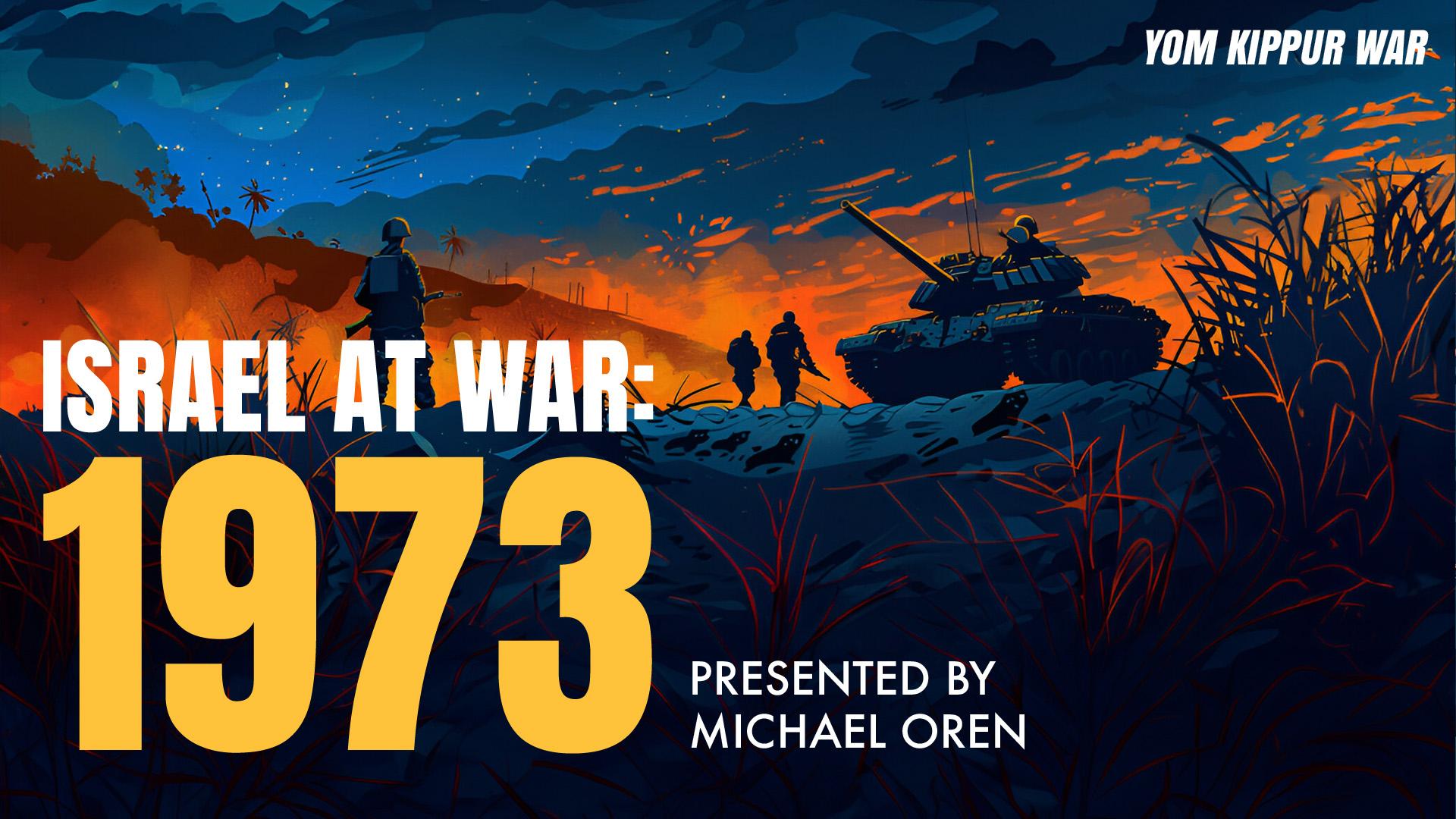
On Yom Kippur 1973, the holiest day of the Jewish year, Israel’s air raid sirens started to blare. Egypt and Syria—still bitter over Israel’s victory in the Six-Day War—had launched a surprise attack. Israel’s survival hung in the balance. How it responded in this existential moment shaped Middle East history for the next five decades.
Click here to watch every video in the Israel at War series.
Hosted By
 Michael Oren
The date was October 6, 1973, Yom Kippur, the holiest day of the Jewish year.
Synagogues in Israel were filled with Jews fasting and praying.
Then, at precisely 2:00 p.m., air raid sirens started to blare.
The prayers stopped.
In their place came whispers—rumors of war.
But they weren’t rumors.
In the south, an Egyptian force of 100,000 soldiers backed by 1,300 Soviet-made tanks was crossing the Suez Canal.
They quickly overran a series of fortifications Israel had constructed along the Canal following the 1967 Six-Day War.
Israeli fighter jets scrambled to meet the invading force, but the Egyptians were ready with the latest generation of Soviet-designed anti-aircraft batteries. Israeli tanks ran into a deadly barrage of anti-tank missiles. These were weapons Egypt didn’t possess in 1967, and Israel wasn’t prepared to deal with them.
The Egyptians inflicted hundreds of casualties, but the Sinai desert is deep and far from Israel’s southern border.
There was no such buffer in the north.
Hundreds of Syrian tanks, outnumbering Israeli tanks five to one, broke through Israeli defenses on the Golan Heights.
That night, Israel’s legendary Defense Minister, Moshe Dayan, appeared on Israeli television and broke down in front of the cameras, telling viewers that the Jewish state was in danger of total destruction.
How did this disaster happen?
There’s one simple answer: complacency.
After winning a lightning victory in the Six-Day War six years earlier, Israeli leaders assumed that the Arabs wouldn’t dare to launch another war so soon.
It was worse than that. Israeli leaders had credible intelligence that Egyptian President Anwar Sadat and Syrian dictator Hafez al-Assad were planning an attack. But they simply dismissed those reports as overwrought.
Anyway, who would ever think that the Arabs would attack on the holiest day of the Jewish calendar?
Only the day before, October 5, with Egyptian and Syrian forces now massed on Israel’s borders, did Prime Minister Golda Meir, Dayan, and other Israeli officials finally conclude that war was about to happen.
Israel frantically called up its reserves.
Golda Meir, meanwhile, phoned U.S. Secretary of State Henry Kissinger, asking for support to mount a preemptive strike. But Kissinger said no. If Israel attacked first, he explained, it would be seen as the aggressor.
This hesitation cost Israel dearly.
As enemy armies broke through Israel’s defenses, tens of thousands of reservists rushed out of their synagogues. They didn’t go home. They went straight to the front.
The fighting in the north was brutal, often hand-to-hand. But within 48 hours, Israeli forces had halted the Syrian advance on the Golan Heights.
In the south, it was a different story. The Egyptian Third Army repulsed Israel’s counterattack.
The pressure on Golda Meir was overwhelming. Normally a five-pack-a-day smoker, she was up to nine.
Just as the situation looked hopeless, Israeli General Ariel Sharon came up with an audacious plan.
He would lead a combined division of tanks and paratroopers across the Suez Canal, cutting off the Egyptian Third Army from behind and surrounding it.
The problem was how to get the pontoon bridges to the Suez Canal through heavily defended Egyptian lines. Some of the fiercest fighting of the war followed, but in the end, Israeli forces broke through and crossed the Canal.
Israel was back in control. The Egyptian Third Army – 20,000 men – now surrounded, faced obliteration.
Enter the superpowers: the Soviet Union on the side of Egypt and Syria; the United States on the side of Israel.
As fast as Egyptian and Syrian forces were losing planes, tanks, and missiles, the Soviet Union was resupplying them.
And as fast as Israel was losing its armaments, the U.S. was resupplying Israel – 22,000 tons of military aid authorized by U.S. President Richard Nixon.
But then, to save the Third Army, the Soviets moved their nuclear-armed fleet to the Eastern Mediterranean where it went “eyeball to eyeball” with the U.S. Sixth Fleet.
For the first time since the Cuban Missile Crisis in 1962, both superpowers went on nuclear alert.
A regional conflict was threatening to become a world war.
Kissinger pressured Meir to stand down. Israel had successfully repelled the invasion, he argued; it was no longer in danger. The Soviets, in turn, convinced Sadat and Assad that a cease-fire would be better than having their armies annihilated.
Negotiations between the warring parties soon followed.
After three bloody weeks, the Yom Kippur War was over.
Caught off-guard on the first day, Israel rebounded and ended the war with its artillery within range of both Cairo and Damascus—a military feat still studied at West Point.
Nevertheless, the Israelis, who lost over 2,600 men, consider the Yom Kippur War a disaster.
The Egyptians, conversely, consider the October War, as they call it, a glorious victory. Even though they were defeated at the war’s end and lost 15,000 men, they had given Israel a terrible shock.
That belief made Sadat a hero in the eyes of his own people. He was the warrior who restored their national honor.
Six years later, with this new credibility, Sadat joined with Israeli Prime Minister Menachem Begin and U.S. President Jimmy Carter in signing the peace treaty between Egypt and Israel that endures to this day.
I’m Michael Oren, author of Six Days of War, for Prager University.