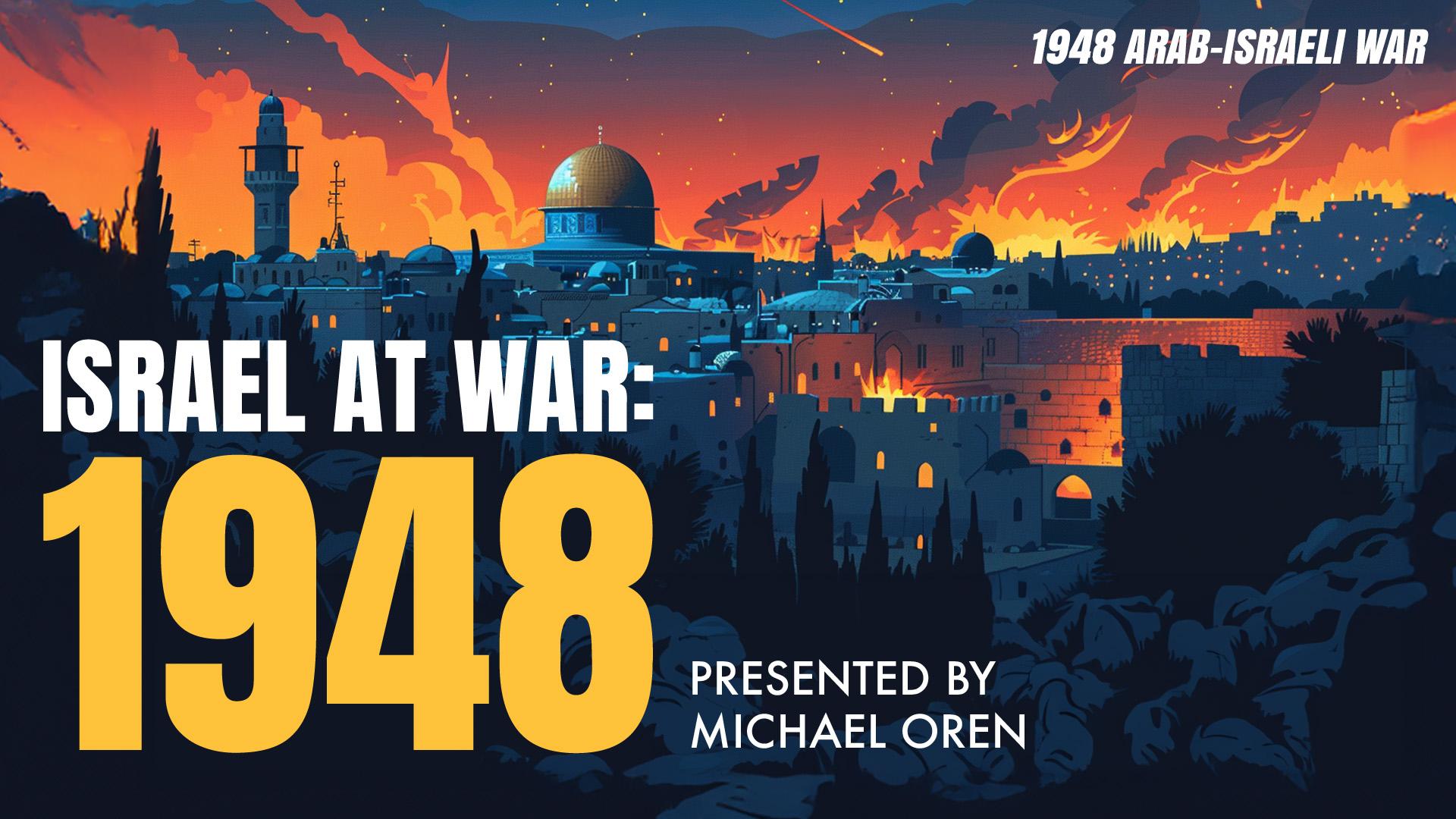
Israel at War: 1948
Two thousand years after being expelled from their ancient homeland, and a mere three years after the Holocaust, the modern state of Israel was established by the United Nations. But having a legal claim to the land was one thing—being able to keep it was another. Michael Oren tells the tale of Israel’s War of Independence.
Click here to watch every video in the Israel at War series.
Hosted By
 Michael Oren
On November 29, 1947, after a hotly contested debate, the United Nations decided to partition British-ruled Palestine into two separate states, one for the Jews and one for the Arabs.
After 2,000 years of exile, and a mere three years after the Holocaust, the Jews would once again be a free nation in their ancient homeland. But having a claim to land was one thing – being able to keep it was another. The Jews were euphoric, but the Arabs were enraged. They swore to destroy the Jewish state before it could even be born.
Arab armies, supplied with tanks, guns, and planes by Britain and France, were poised to attack the Jewish forces, who were only lightly armed.
“It will be a war of annihilation,” declared Azzam Pasha, Secretary-General of the Arab League.
And the threat was not idle.
The war can be broken down into four phases.
The first phase began immediately after the UN partition resolution in November 1947.
Palestinian Arabs and irregulars from Syria, Lebanon, and Gaza attacked Jewish settlements.
Arab forces also laid siege to Jerusalem, depriving 100,000 Jews of food and water. Repeated Jewish attempts to break the siege were repulsed.
The situation was desperate. While frantically trying to procure weapons from abroad, Zionist leader David Ben-Gurion, fearful that the world would retreat from the partition resolution, refrained from ordering a counter-offensive. But the Arab attacks proved too devastating, forcing the Jews to strike back.
In brutal battles, the Jews scored victories in Haifa, Safed, Jaffa, and Tiberias. Assuming these defeats were only temporary, tens of thousands of Arabs fled to neighboring states.
The violence reached a pitch in April 1948 when Zionist forces attacked the Arab town of Deir Yassin, resulting in what the Arabs claim was a massacre. Arab gunmen then ambushed a medical convoy to Hadassah Hospital in Jerusalem, killing 78 doctors and nurses.
A month later, Arab forces overwhelmed the Jewish defenders of the Etzion Block of settlements south of Jerusalem. 127 men and women were slaughtered.
By mid- May when the state was set to come into being, its survival was far from certain. Laboring under an American arms embargo, the Jewish forces only had enough bullets to fight for one week. Jerusalem was cut off, and settlements throughout the country were isolated. Fearing a second Holocaust, Zionist leaders were divided about whether or not to even declare the state.
Nevertheless, on Friday, May 14, Ben-Gurion entered the Tel Aviv Art Museum, chosen because its thick walls could withstand an anticipated Arab air attack and proclaimed the independence of the reborn Jewish state—to be known as the State of Israel.
Eleven minutes later, President Harry Truman made the United States the first nation to recognize the Jewish state.
The second phase of the war was about to begin. And Israel’s situation was only going to get worse.
The Arabs had promised to invade the moment Israel declared independence. And they did, their five armies conquering large parts of the Galilee in the north and the Negev in the south. Egyptian forces advanced within twenty miles of Tel Aviv.
In the Old City of Jerusalem, Israeli fighters tried and failed to defend the ancient Jewish Quarter, which was conquered and looted by the Arabs.
Yet as bad as it was for the Jews, it was almost as bad for the Arabs. They had also suffered severe losses and had seriously underestimated the strength of Israel’s resistance.
So when a U.N. truce was proposed on June 11, both sides agreed.
Israel used the truce to procure more advanced weaponry and absorb tens of thousands of immigrants, many of them Holocaust survivors. These new arrivals were given guns and immediately sent into battle.
The Egyptians broke the truce by attacking an Israeli village in the Negev. Israel responded by advancing on all fronts.
The third phase of the war had begun.
Among the cities taken by Israel were Lod and Ramle, whose Arab inhabitants either fled or were expelled.
All told, nearly 700,000 Palestinians became refugees in what they still call today the Nakhba, the Disaster. Roughly an equal number of Jews were later expelled from Arab countries.
Another truce was declared on July 18 and lasted until mid-October, when the fourth and final phase of the war began. By now, the balance of power had shifted.
Adequately armed, the Israel Defense Forces, the IDF, drove the invaders beyond the original partition lines. The last operation of the war took place in March 1949, when IDF troops raised a hand-painted Israeli flag over the Red Sea village of Umm Al-Rashrash, soon to be renamed Eilat.
Israel’s War of Independence ended with armistice agreements negotiated by American diplomat Ralphe Bunche. He was the first black American to be awarded a Nobel Prize.
The war was costly, resulting in the deaths of 6,000 Israelis—one percent of the population. Jerusalem was divided between Jewish west and Arab east, with the Old City remaining in Jordanian hands. Nearly two decades would pass before Jews could once again pray at the Western Wall.
The Palestinian refugee problem became a perennial source of Middle East instability and conflict.
But the most momentous outcome of the war was the rebirth, after two thousand years of exile, of a strong and sovereign Jewish state. The State of Israel.
I’m Michael Oren, author of Six Days of War, for Prager University.