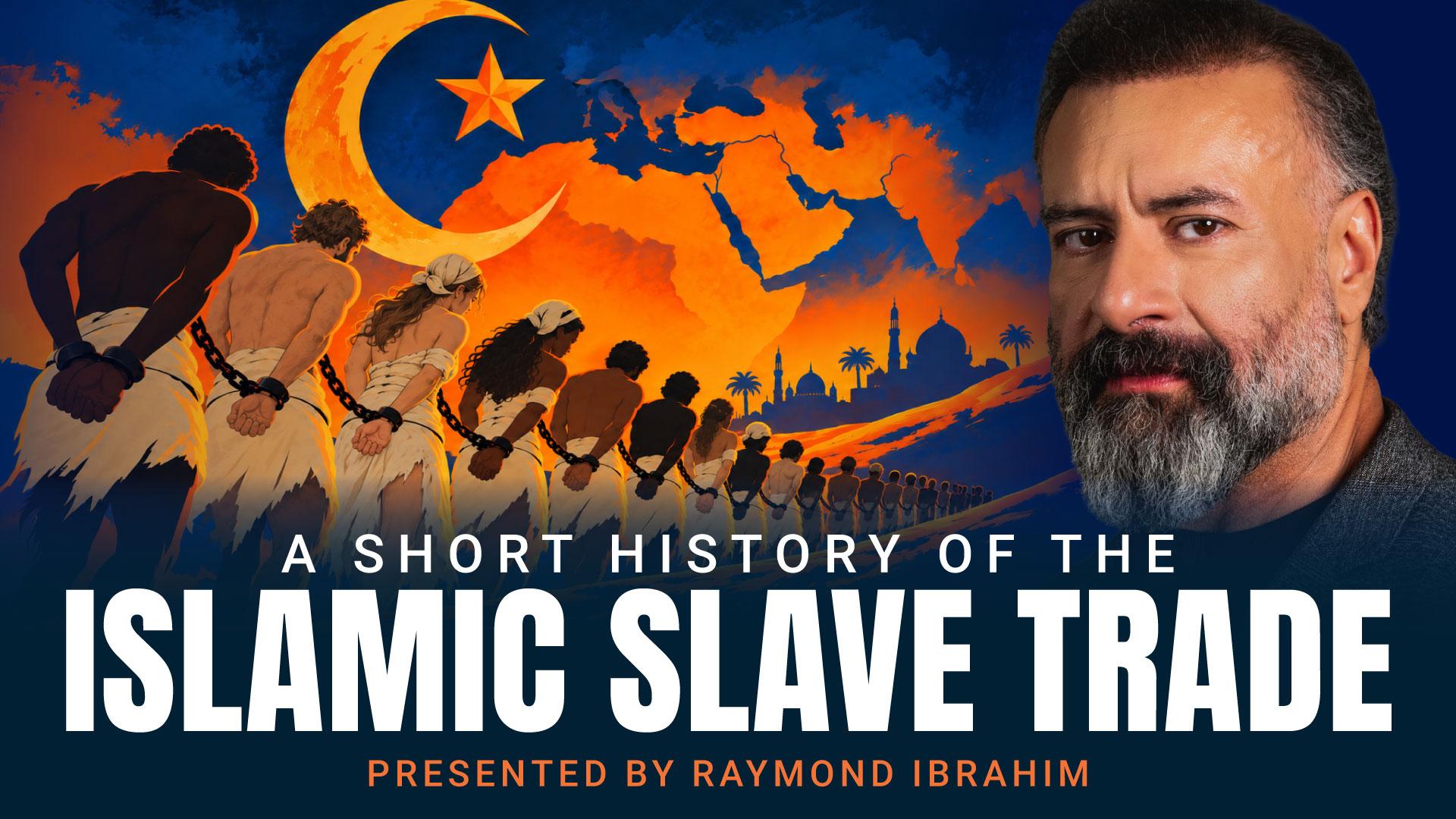
A Short History of the Islamic Slave Trade
Say the word slavery, and most people picture one thing: whites enslaving blacks. But for thirteen centuries, the Islamic world ran a slave trade of its own, enslaving fifty times more than were ever brought to America. So, why does almost no one know this? Middle East historian Raymond Ibrahim explains.
Substack: LINK
Most relevant book: Sword and Scimitar: Fourteen Centuries of War between Islam and the West
Topics
Hosted By
 Raymond Ibrahim
Say the word “slavery,” and nearly everyone immediately thinks of whites—especially Americans—enslaving blacks.
This is hardly surprising. It’s what students have been taught for decades.
Rutgers professor of Africana Studies, Brittney Cooper, strongly implies that whites invented slavery. “Prior to [whites],” Cooper contends, “black and brown people have been sailing across oceans, interacting with each other for centuries without total subjugation, domination and colonialism…”
Cooper’s view is now conventional academic thinking.
But it’s wrong.
Slavery has existed since the beginning of recorded time—and often on a scale far greater and far more inhumane than that practiced in the American antebellum South.
Islam is a prime example.
From the start of the Islamic conquests in the seventh century, Muslims enslaved “infidels” across lands now called “the Muslim world,” encompassing most of the Middle East and parts of Asia, Africa, and even Europe. Although it’s impossible to give an exact count — premodern sources are scarce — conservative estimates put the number in the vicinity of twenty million.
White slaves were especially desired. In fact, much of the Viking slave raids on Christian Europeans in the ninth and tenth centuries were fueled by the Abbasid caliphate’s insatiable demand for white captives, especially women.
Oddly, the many Viking movies and series you’ve watched never seem to convey that fact.
When we reach the sixteenth century, we get firmer numbers due to better sources. Over a million Europeans were captured by Muslim raiders, seized from as far away as Iceland, and brought to the Barbary states of northwest Africa alone. This is to say nothing of the enslavement of Europeans by other Muslim powers. Turkish and Mongol Muslims, for example, both enslaved many more millions of Europeans over the course of five centuries.
America’s war against the Barbary pirates in the early 1800s was also provoked by Muslims raiding American ships and enslaving American sailors.
Not only did Muslims surpass everyone else in terms of the sheer numbers of people they enslaved, but also in the harsh treatment of those they enslaved — white and black.
The punishments Muslims inflicted on slaves defy description. The Book of Martyrs — first published in England in 1563 and updated many times — describes the brutality Christian slaves experienced in Barbary: “…they must become Mahometans or be impaled alive. If they profess Christianity again…they are roasted alive or thrown from the city walls and caught upon large sharp hooks, on which they hang till they expire.”
More than two centuries later, little had changed. In 1785, Captain Richard O’Brien of the captured American vessel, the Dauphin, wrote to Thomas Jefferson imploring him to raise a ransom. “Our sufferings,” wrote the enslaved man, “are beyond our expression or your conception.”
As cruelly as Muslims treated white Christians—who were “hated on account of their religion,” said one British consul—they treated pagan blacks even more harshly. Muslim masters regularly castrated their male African slaves. This was done to prevent black blood from “polluting” the Arab race and to prevent the rise of black minority populations.
Contrast this with the American South. There, the enslaved population grew through natural increase—one of the few slave societies in history where it did. This explains why the United States has a large African-descended population today, while much of the Arab world does not—despite importing African slaves in far greater numbers over a far longer period.
It should go without saying that I’m not in any way condoning American slavery. The point here is that there was a vast difference between how Africans were treated in America and how they were treated in Arab countries.
In sum:
From a doctrinal point of view, Islamic law provides a religious justification for the capture and enslavement of non-Muslims—beginning with its founder, Muhammad, who owned slaves, including sex slaves.
From a historic point of view, the Islamic world was a giant slave emporium. Some twenty million souls were enslaved by Muslim empires across 13 centuries. By contrast, the number brought to the US is estimated to be 400,000 over 200 years.
Yet few today are aware of any of this.
They’re also unaware that it was Christians in Europe and America who first abolished slavery, and then pressured the rest of the world into compliance—including the Islamic world, which was still practicing slavery well into the 20th century. Saudi Arabia didn’t officially abolish slavery until 1962.
But as Christian influence continues to retreat around the world, slavery is making a comeback. According to the International Labour Organization, there are today some fifty million people living as slaves — and the vast majority of them are in Africa and Asia.
Despite all this, say the word “slavery,” and nearly everyone immediately thinks of American whites enslaving African blacks.
Surely, it’s well past time to get it right.
I’m Raymond Ibrahim, author of Sword and Scimitar: Fourteen Centuries of War between Islam and the West, for Prager University.